
How Do You Winsorize an Alpha Factor?
Winsorization caps observations at specified lower and upper thresholds while keeping them in the sample. It limits the influence of extreme values on normalization, regression, and position sizing, which can make a factor less sensitive to a few unusually large inputs.
This article works through the calculation for six observations, then explains threshold selection and the order of transformations. It also examines how capping changes the information retained in a signal and how to evaluate that trade-off.
Mathematical definition
Given lower and upper thresholds \(L_t\) and \(H_t\), the winsorized observation is
\[x^{W}_{i,t} = \min\left(\max(x_{i,t},L_t),H_t\right).\]
For count-based symmetric winsorization, sort the \(N_t\) valid observations as \(x_{(1),t}\leq\cdots\leq x_{(N_t),t}\) and choose \(k\) observations in each tail. Then
\[L_t=x_{(k+1),t}, \qquad H_t=x_{(N_t-k),t}.\]
Quantile-based thresholds use estimated percentiles instead. Quantile software offers several interpolation conventions, which can produce different caps in small cross-sections. The quantile method belongs in the recorded definition.
Worked example
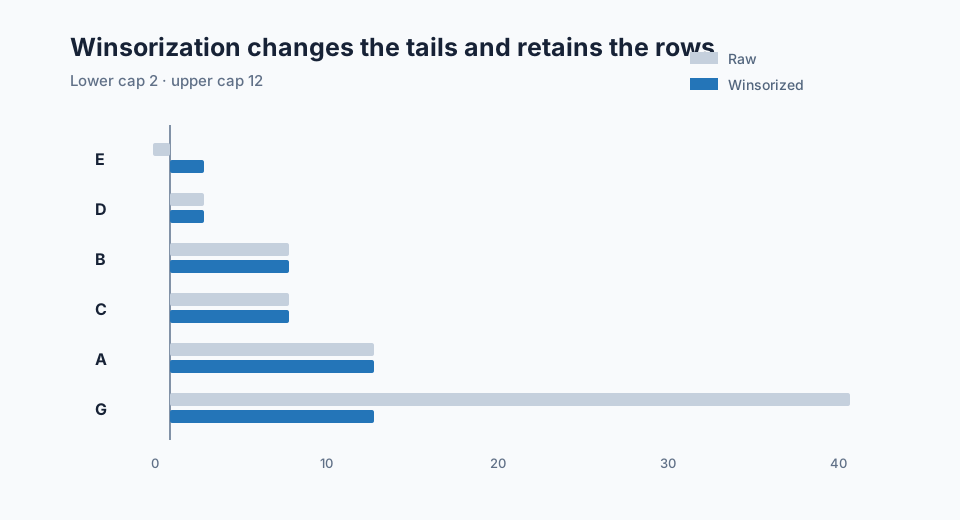
Consider the six values \(-1,2,7,7,12,40\). Their mean is \(11.167\) and their population standard deviation is \(13.533\). Winsorizing one observation in each tail sets the lower cap to 2 and the upper cap to 12.
One-observation-per-tail winsorization
| Security | Raw value | Winsorized value | Change |
|---|---|---|---|
| E | −1 | 2 | +3 |
| D | 2 | 2 | 0 |
| B | 7 | 7 | 0 |
| C | 7 | 7 | 0 |
| A | 12 | 12 | 0 |
| G | 40 | 12 | −28 |
The winsorized values \(2,2,7,7,12,12\) have mean 7 and population standard deviation
\[\sqrt{\frac{(2-7)^2+(2-7)^2+(7-7)^2+(7-7)^2 +(12-7)^2+(12-7)^2}{6}} =4.082.\]
Their z-scores are \(-1.225,-1.225,0,0,+1.225,+1.225\). G remains at the upper end, but its raw distance no longer shifts the centre and scale of every other security.
Python calculation
import pandas as pd

raw = pd.Series({"E": -1.0, "D": 2.0, "B": 7.0,
                 "C": 7.0, "A": 12.0, "G": 40.0})

ordered = raw.sort_values()
k = 1
lower = ordered.iloc[k]
upper = ordered.iloc[-k - 1]
winsorized = raw.clip(lower=lower, upper=upper)
z_score = (winsorized - winsorized.mean()) / winsorized.std(ddof=0)

print(pd.DataFrame({"raw": raw, "winsorized": winsorized, "z": z_score}))
For a quantile rule, calculate the two thresholds with an explicitly selected
quantile method, then use the same clip operation.
What happens to signs and zeros
Winsorization usually preserves the ordering direction, but it can alter signs when a cap crosses zero. In the example, the lower observation changes from \(-1\) to \(+2\) because the selected lower cap is positive. A later demeaning or z-score restores a relative centre, yet the capped raw field has lost its original sign.
Zero has no special role unless the economic measurement gives it one. The cap should follow the cross-sectional rule rather than an assumption that all factors must remain symmetric around zero.
Winsorization, trimming, and ranking
Trimming removes tail observations from the calculation. Winsorization keeps them and changes their values. Ranking keeps all valid observations and replaces raw distances with ordered positions. These procedures therefore change coverage and information in different ways.
For an invalid data point, correction or exclusion is preferable. For a valid heavy-tailed characteristic, winsorization or ranking can make downstream estimates less sensitive to isolated magnitudes. Comparing the resulting versions reveals whether a factor depends on a few extremes.
Choosing thresholds
A practical threshold policy should state:
- whether caps are symmetric or separate by tail;
- whether they are count, quantile, robust-scale, or domain bounds;
- the cross-sectional universe and any peer groups;
- the quantile interpolation method;
- minimum valid sample size;
- treatment of ties at the cap;
- the order of validation, winsorization, neutralization, and normalization.
Large liquid universes may support stable 1% or 2.5% tail estimates. A small sector group may not. Fixed economic bounds can be more appropriate for ratios with known feasible ranges, while median-and-MAD rules can adapt to dispersion.
Applying the caps consistently
Validate the source values before estimating caps. Split errors, mixed units, stale records, and impossible denominators require correction or exclusion; capping them can leave an erroneous observation at an apparently valid endpoint. Preserve the original value, capped value, thresholds, and a tail flag so the transformation can be audited.
Estimate cross-sectional caps at each date and rolling time-series caps from prior observations. Keep the grouping rule and fallback stable throughout the test. Global caps may leave a small sector concentrated at the extremes, while within-sector estimates can be unstable when few securities are available.
The order of transformations also affects the result. Capping raw values before standardization changes the estimated mean and scale. Capping z-scores afterward retains the influence of the original extremes on those estimates. Record the order in the factor definition and assess threshold sensitivity within training and robustness analysis, reserving the holdout for evaluation.
Signal and portfolio consequences
Winsorization can change composite weights because the mean and scale of one input change before combination. It can also reduce large proportional positions and turnover caused by unstable extremes. Rank IC may change little when order is preserved, while Pearson IC and portfolio returns change substantially because they retain magnitude.
Evaluate the uncapped and capped versions on identical security-date pairs. Compare rank and Pearson IC, quantile spreads, concentration, turnover, tail loss, and the contribution of capped observations. A factor whose evidence disappears under modest caps deserves a clear explanation of why the extremes are economically essential.
Frequently asked questions
Should every alpha factor be winsorized?
No. Bounded or already ranked inputs may not need it. The decision depends on data validity, distribution, economic meaning, and downstream sensitivity.
Can the two tails use different thresholds?
Yes. Some characteristics have one economically meaningful hard boundary and one long unbounded tail. An asymmetric rule can reflect that structure if it is declared before evaluation.
Should winsorization happen before sector neutralization?
Usually the raw field is validated and capped before estimating cross-sectional neutralization, so a single extreme cannot dominate group means or regression coefficients. The order should be tested and recorded because it affects the result.
Next reading
- Should Alpha Factors Be Z-Scored or Ranked?
- What Is Cross-Sectional Ranking?
- How Should Missing Factor Values Be Handled?
Sources
This walkthrough is for research and educational purposes. It illustrates how strategynet.ai organizes signal evidence into factors and scenarios. It provides no recommendation, investment advice, or instruction to trade any security.
Back to Insights